Nvidia's board reinstated Jensen Huang as president, chief executive and director on Monday, effective immediately, 11 days after he resigned from the company he co-founded. The board said the vote was unanimous and followed a series of meetings with Huang, after which it was satisfied with his "candor and ability to lead." Colette Kress, who had served as interim CEO, returns to her job as chief financial officer, and Harvey Jones stays on as board chair.
The decision reverses a position the board took six days earlier. On the Nov. 17 earnings call, Jones said the board had unanimously accepted Huang's resignation and did not intend to reinstate him, InvestmentNews reported. A day before that, a person familiar with the matter told CNBC the board was not in talks to bring him back and had begun choosing a search firm.
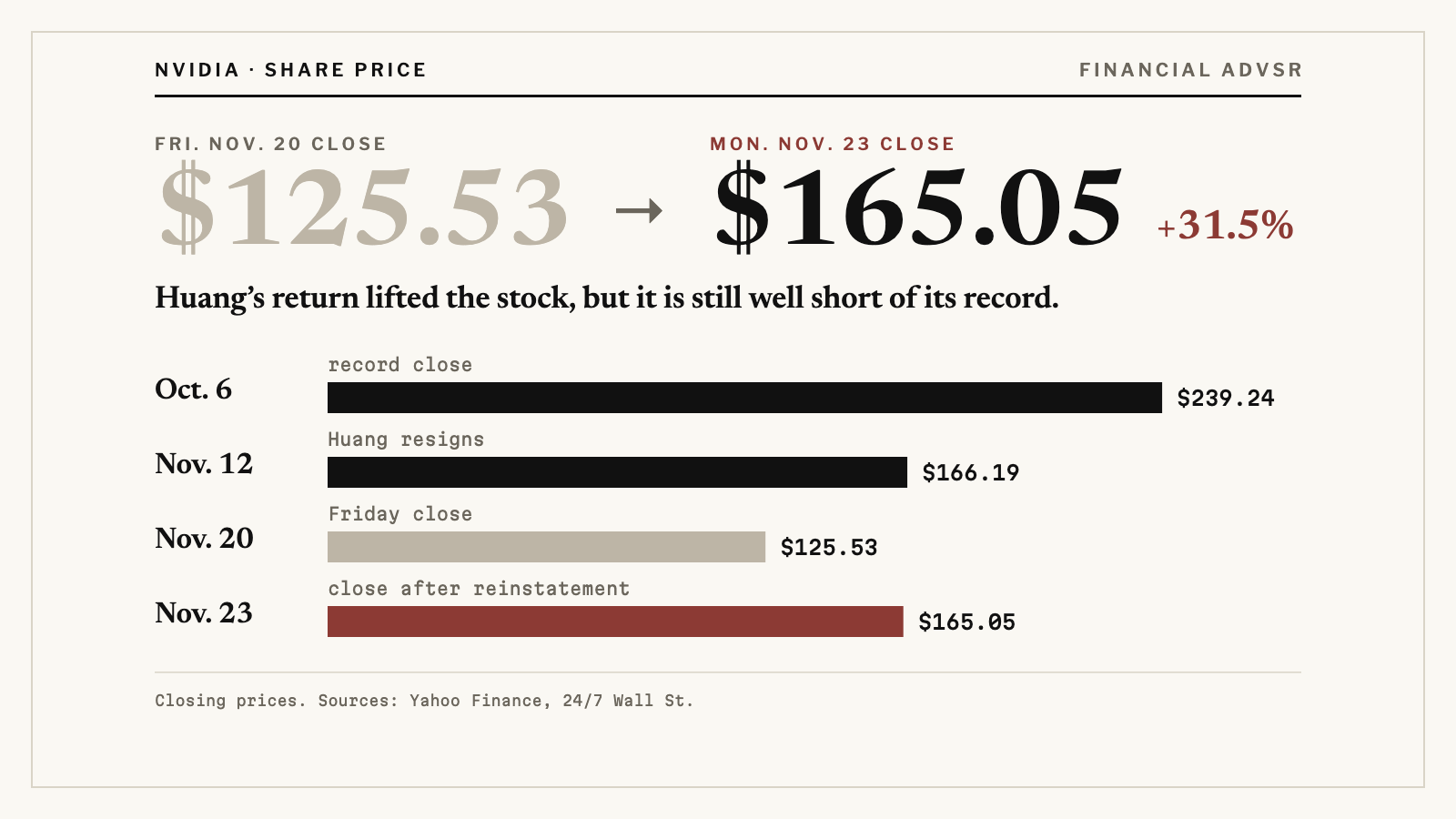
Investors cheered the reversal. Nvidia shares closed at $165.05, up 31.5% from Friday's $125.53, after trading as high as $171.50 during the session, according to Yahoo Finance market data. Even after the jump, the stock finished just below the $166.19 close of Nov. 12, the day Huang stepped down, and about 31% below its Oct. 6 record close of $239.24, according to 24/7 Wall St. Chip and AI stocks rallied with it, and the Dow, the S&P 500 and the Nasdaq posted their best day since April 2025, Yahoo Finance reported.
Huang resigned after reports of extramarital affairs, including one with Alice Huang, a former executive at Singapore-based Megaspeed whom U.S. intelligence officials believe works for China's intelligence services, according to InvestmentNews. Beijing has denied the claim. In Monday's announcement, the board said it had received input from senior levels of the U.S. government and was confident Huang's return "poses no national security risk."
The return followed a week of public pressure. President Trump urged the board on Truth Social to rehire Huang. An online "Stand with Jensen" letter passed 206,000 signatures, including more than 10,000 people who identified as Nvidia employees, InvestmentNews reported. Shareholders Altimeter Capital and Atreides Management asked the board to keep a return on the table. Huang owns roughly 3.5% of the company.
The questions that pushed him out are still open. The board said the committee of independent directors it formed to investigate reports that Huang was the target of a foreign intelligence effort "will proceed to conclusion," and that Huang will cooperate. CNBC has reported that the board hired Wachtell Lipton to lead that review. Nvidia also said it is forming a National Security and Export Control Committee made up only of independent directors and is searching for a new chief compliance officer who will report to the board's nominating and governance committee. The company said it will keep cooperating with government investigations.
Those include a civil Securities and Exchange Commission probe, first reported by The Wall Street Journal on Nov. 17, into whether Nvidia's disclosures misled investors. Neither the SEC nor Nvidia has confirmed it. Nvidia settled earlier SEC charges in 2022, paying $5.5 million over disclosures about cryptomining's role in its gaming revenue. Huang is also scheduled to sit for a closed-door transcribed interview on Dec. 1 with three House committees looking at possible diversion of advanced Nvidia chips to China, according to InvestmentNews.
For the wealth management business, the episode has been a test of how much of a client's portfolio rides on one company. Nvidia made up about 6.1% of the SPDR S&P 500 ETF Trust at the Nov. 12 close and 6.5% of the Invesco QQQ Trust, according to holdings data compiled by Trefis, compared with 0.15% of the equal-weight Invesco S&P 500 Equal Weight ETF. The stock sits in 1,068 U.S.-listed ETFs and is a top-15 holding in 628 of them, Strategy Shares head of ETFs Ed Rosenberg told InvestmentNews. Some sector funds hold far more: the Strive U.S. Semiconductor ETF had about 19.3% in Nvidia, according to Seeking Alpha.